Loading...
Searching...
No Matches
Syscall Interface
Linux-compatible syscall numbers and kernel syscall initialisation. More...
Macros | |
| #define | SYS_read 0 |
| #define | SYS_write 1 |
| #define | SYS_open 2 |
| #define | SYS_close 3 |
| #define | SYS_stat 4 |
| #define | SYS_fstat 5 |
| #define | SYS_lstat 6 |
| #define | SYS_waitpid 7 |
| #define | SYS_lseek 8 |
| #define | SYS_mmap 9 |
| #define | SYS_mprotect 10 |
| #define | SYS_munmap 11 |
| #define | SYS_signal 13 |
| #define | SYS_sigreturn 15 |
| #define | SYS_ioctl 16 |
| #define | SYS_pread64 17 |
| #define | SYS_pwrite64 18 |
| #define | SYS_access 21 |
| #define | SYS_pipe 22 |
| #define | SYS_poll 23 |
| #define | SYS_select 24 |
| #define | SYS_dup 32 |
| #define | SYS_dup2 33 |
| #define | SYS_nanosleep 35 |
| #define | SYS_getpid 39 |
| #define | SYS_fork 57 |
| #define | SYS_execve 59 |
| #define | SYS_exit 60 |
| #define | SYS_wait4 61 |
| #define | SYS_kill 62 |
| #define | SYS_gettimeofday 96 |
| #define | SYS_sysinfo 99 |
| #define | SYS_chmod 90 |
| #define | SYS_statfs 137 |
| #define | SYS_fstatfs 138 |
| #define | SYS_mknod 133 |
| #define | SYS_fcntl 72 |
| #define | SYS_ftruncate 77 |
| #define | SYS_getdents 78 |
| #define | SYS_brk 79 |
| #define | SYS_getcwd 80 |
| #define | SYS_chdir 81 |
| #define | SYS_rename 82 |
| #define | SYS_mkdir 83 |
| #define | SYS_rmdir 84 |
| #define | SYS_unlink 87 |
| #define | SYS_symlink 88 |
| #define | SYS_readlink 89 |
| #define | SYS_ptrace 101 |
| #define | SYS_setpgid 109 |
| #define | SYS_getppid 110 |
| #define | SYS_setsid 112 |
| #define | SYS_mount 165 |
| #define | SYS_umount 166 |
| #define | SYS_sigaction 174 |
| #define | SYS_sched_getcpu 318 |
| #define | SYS_clock_gettime 228 |
| #define | SYS_socket 41 |
| #define | SYS_connect 42 |
| #define | SYS_accept 43 |
| #define | SYS_sendto 44 |
| #define | SYS_recvfrom 45 |
| #define | SYS_shutdown 48 |
| #define | SYS_bind 49 |
| #define | SYS_listen 50 |
| #define | SYS_socketpair 53 |
| #define | SYS_setsockopt 54 |
| #define | SYS_getsockopt 55 |
| #define | SYS_clone 56 |
| #define | SYS_arch_prctl 158 |
| #define | SYS_gettid 186 |
| #define | SYS_futex 202 |
| #define | SYS_set_tid_address 218 |
| #define | SYS_setitimer_miniOS 452 |
| #define | SYS_alarm_miniOS 453 |
| #define | SYS_register_sigtrampoline 454 |
Functions | |
| void | syscall_save_restart_state (uint64_t nr, uint64_t a1, uint64_t a2, uint64_t a3, uint64_t a4, uint64_t a5, uint64_t a6) |
| void | syscall_init (void) |
| Writes IA32_LSTAR MSR to the address of syscall_entry (the NASM entry stub in syscall.asm), writes IA32_STAR MSR with kernel CS (0x08) and user CS (0x1B) selectors, writes IA32_FMASK to mask IF during syscall entry (interrupts disabled at syscall boundary), and sets SCE bit in IA32_EFER. Called once by the BSP during boot. | |
| void | syscall_get_saved_user_rdi_rsi_rdx (uint64_t *out_rdi, uint64_t *out_rsi, uint64_t *out_rdx) |
| The SYSCALL instruction clobbers RCX and R11; arguments in RDI/RSI/RDX are preserved by the syscall.asm stub in per-CPU scratch space. This helper exposes them to kernel C code (e.g., SYS_execve handler) that needs all three argument registers. | |
Detailed Description
Linux-compatible syscall numbers and kernel syscall initialisation.
Defines SYS_* constants matching the Linux x86-64 ABI syscall table. The syscall entry point (syscall.asm) dispatches on RAX to the kernel syscall dispatcher in syscall.c, which fans out to four independent compilation units: syscall_mm.c (memory, brk, mmap, gettimeofday, clock_gettime), syscall_fs.c (VFS, poll, select, pipe, dup, ioctl, getdents, fcntl), syscall_proc.c (fork, execve, exit, wait, signals), and syscall_net.c (socket, bind, connect, sendto, recvfrom, accept). Supports 45+ syscalls covering file I/O, process management, memory management, networking, signals, and terminal control.
Macro Definition Documentation
◆ SYS_accept
| #define SYS_accept 43 |
◆ SYS_access
| #define SYS_access 21 |
◆ SYS_alarm_miniOS
| #define SYS_alarm_miniOS 453 |
◆ SYS_arch_prctl
| #define SYS_arch_prctl 158 |
◆ SYS_bind
| #define SYS_bind 49 |
◆ SYS_brk
| #define SYS_brk 79 |
◆ SYS_chdir
| #define SYS_chdir 81 |
◆ SYS_chmod
| #define SYS_chmod 90 |
◆ SYS_clock_gettime
| #define SYS_clock_gettime 228 |
◆ SYS_clone
| #define SYS_clone 56 |
◆ SYS_close
| #define SYS_close 3 |
◆ SYS_connect
| #define SYS_connect 42 |
◆ SYS_dup
| #define SYS_dup 32 |
◆ SYS_dup2
| #define SYS_dup2 33 |
◆ SYS_execve
| #define SYS_execve 59 |
◆ SYS_exit
| #define SYS_exit 60 |
◆ SYS_fcntl
| #define SYS_fcntl 72 |
◆ SYS_fork
| #define SYS_fork 57 |
◆ SYS_fstat
| #define SYS_fstat 5 |
◆ SYS_fstatfs
| #define SYS_fstatfs 138 |
◆ SYS_ftruncate
| #define SYS_ftruncate 77 |
◆ SYS_futex
| #define SYS_futex 202 |
◆ SYS_getcwd
| #define SYS_getcwd 80 |
◆ SYS_getdents
| #define SYS_getdents 78 |
◆ SYS_getpid
| #define SYS_getpid 39 |
◆ SYS_getppid
| #define SYS_getppid 110 |
◆ SYS_getsockopt
| #define SYS_getsockopt 55 |
◆ SYS_gettid
| #define SYS_gettid 186 |
◆ SYS_gettimeofday
| #define SYS_gettimeofday 96 |
◆ SYS_ioctl
| #define SYS_ioctl 16 |
◆ SYS_kill
| #define SYS_kill 62 |
◆ SYS_listen
| #define SYS_listen 50 |
◆ SYS_lseek
| #define SYS_lseek 8 |
◆ SYS_lstat
| #define SYS_lstat 6 |
◆ SYS_mkdir
| #define SYS_mkdir 83 |
◆ SYS_mknod
| #define SYS_mknod 133 |
◆ SYS_mmap
| #define SYS_mmap 9 |
◆ SYS_mount
| #define SYS_mount 165 |
◆ SYS_mprotect
| #define SYS_mprotect 10 |
◆ SYS_munmap
| #define SYS_munmap 11 |
◆ SYS_nanosleep
| #define SYS_nanosleep 35 |
◆ SYS_open
| #define SYS_open 2 |
◆ SYS_pipe
| #define SYS_pipe 22 |
◆ SYS_poll
| #define SYS_poll 23 |
◆ SYS_pread64
| #define SYS_pread64 17 |
◆ SYS_ptrace
| #define SYS_ptrace 101 |
◆ SYS_pwrite64
| #define SYS_pwrite64 18 |
◆ SYS_read
| #define SYS_read 0 |
◆ SYS_readlink
| #define SYS_readlink 89 |
◆ SYS_recvfrom
| #define SYS_recvfrom 45 |
◆ SYS_register_sigtrampoline
| #define SYS_register_sigtrampoline 454 |
◆ SYS_rename
| #define SYS_rename 82 |
◆ SYS_rmdir
| #define SYS_rmdir 84 |
◆ SYS_sched_getcpu
| #define SYS_sched_getcpu 318 |
◆ SYS_select
| #define SYS_select 24 |
◆ SYS_sendto
| #define SYS_sendto 44 |
◆ SYS_set_tid_address
| #define SYS_set_tid_address 218 |
◆ SYS_setitimer_miniOS
| #define SYS_setitimer_miniOS 452 |
◆ SYS_setpgid
| #define SYS_setpgid 109 |
◆ SYS_setsid
| #define SYS_setsid 112 |
◆ SYS_setsockopt
| #define SYS_setsockopt 54 |
◆ SYS_shutdown
| #define SYS_shutdown 48 |
◆ SYS_sigaction
| #define SYS_sigaction 174 |
◆ SYS_signal
| #define SYS_signal 13 |
◆ SYS_sigreturn
| #define SYS_sigreturn 15 |
◆ SYS_socket
| #define SYS_socket 41 |
◆ SYS_socketpair
| #define SYS_socketpair 53 |
◆ SYS_stat
| #define SYS_stat 4 |
◆ SYS_statfs
| #define SYS_statfs 137 |
◆ SYS_symlink
| #define SYS_symlink 88 |
◆ SYS_sysinfo
| #define SYS_sysinfo 99 |
◆ SYS_umount
| #define SYS_umount 166 |
◆ SYS_unlink
| #define SYS_unlink 87 |
◆ SYS_wait4
| #define SYS_wait4 61 |
◆ SYS_waitpid
| #define SYS_waitpid 7 |
◆ SYS_write
| #define SYS_write 1 |
Function Documentation
◆ syscall_get_saved_user_rdi_rsi_rdx()
| void syscall_get_saved_user_rdi_rsi_rdx | ( | uint64_t * | out_rdi, |
| uint64_t * | out_rsi, | ||
| uint64_t * | out_rdx ) |
The SYSCALL instruction clobbers RCX and R11; arguments in RDI/RSI/RDX are preserved by the syscall.asm stub in per-CPU scratch space. This helper exposes them to kernel C code (e.g., SYS_execve handler) that needs all three argument registers.
syscall_get_saved_user_rdi_rsi_rdx() - Retrieve user-mode argument registers saved at syscall entry.
- Parameters
-
out_rdi Output pointer; set to the user's RDI value at SYSCALL entry. out_rsi Output pointer; set to the user's RSI value at SYSCALL entry. out_rdx Output pointer; set to the user's RDX value at SYSCALL entry.
Here is the call graph for this function:

Here is the caller graph for this function:
◆ syscall_init()
| void syscall_init | ( | void | ) |
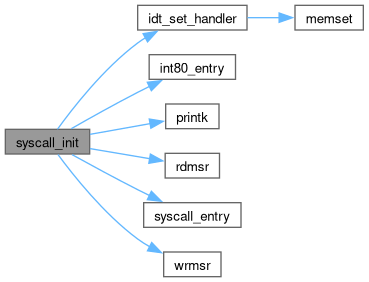
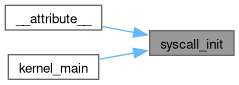
Writes IA32_LSTAR MSR to the address of syscall_entry (the NASM entry stub in syscall.asm), writes IA32_STAR MSR with kernel CS (0x08) and user CS (0x1B) selectors, writes IA32_FMASK to mask IF during syscall entry (interrupts disabled at syscall boundary), and sets SCE bit in IA32_EFER. Called once by the BSP during boot.
syscall_init() - Initialise the SYSCALL/SYSRET mechanism.
Here is the call graph for this function:
Here is the caller graph for this function:
◆ syscall_save_restart_state()
| void syscall_save_restart_state | ( | uint64_t | nr, |
| uint64_t | a1, | ||
| uint64_t | a2, | ||
| uint64_t | a3, | ||
| uint64_t | a4, | ||
| uint64_t | a5, | ||
| uint64_t | a6 ) |
syscall_save_restart_state() - Save syscall nr + args for SA_RESTART replay. @nr, @a1..@a6: Syscall number and all 6 arguments at syscall entry.
Called as the FIRST action in syscall_dispatch(). Records the syscall state in the current thread so SYS_sigreturn can replay it if SA_RESTART applies. Clears syscall_restart_pending (set by blocking syscalls that were interrupted).
Here is the call graph for this function:

Here is the caller graph for this function: